


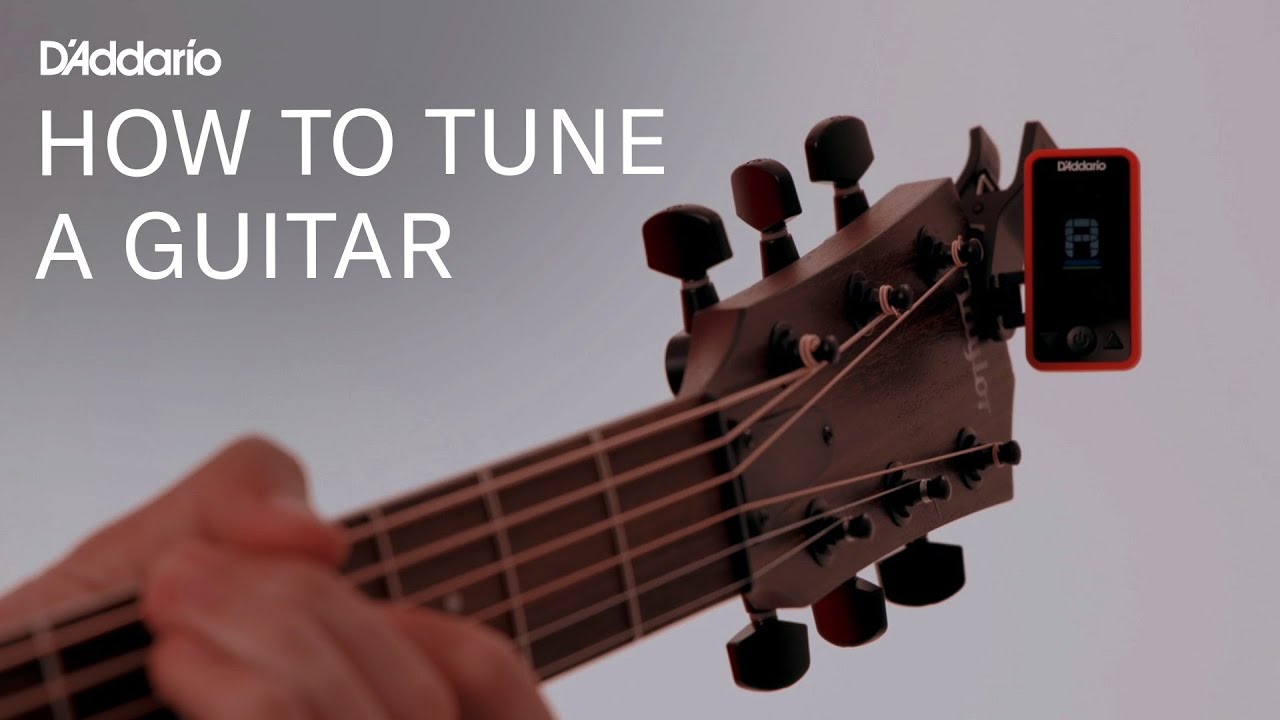
How To Tune A Guitar
Why Guitar Tuning Matters
How Proper Tuning Improves Your Sound and Technique
Proper tuning is the foundation for any guitar playing journey. Regular practice tuning by ear helps develop pitch recognition and improves tuning accuracy over time. It helps every chord and note ring cleanly, empowers you to learn accurate pitch recognition, makes it possible to learn your favorite songs or jam in a group, and is a launchpad for developing technique.
Common Signs Your Guitar Is Out of Tune
If you have to ask if you’re out of tune while playing, you’re probably out of tune. More specifically, if chords sound sour, single notes clash with recordings, or your guitar seems to drift pitch after a few minutes of playing, you should grab a tuner. Temperature changes, old strings, and heavy playing can all cause tuning instability.
Understanding Standard Guitar Tuning (EADGBE)
The 6 Guitar String Notes Explained
Standard tuning is E–A–D–G–B–E, from lowest pitch to highest. The six strings are typically referred to as the sixth string (lowest/thickest), fifth string (A), fourth string (D), third string (G), second string (B), and first string (highest/thinnest, also called the high E string).
How to Tune Your Guitar to Standard Tuning
Use a clip-on, pedal, or app-based guitar tuner to match each string to its target pitch, using the tuning pegs to adjust string tension and pitch. You can also use a pitch pipe or tuning fork as a reference pitch to tune a guitar accurately. To tune a guitar, start with the low E string, pluck it, and adjust the tuning peg until the tuner (and your ear) indicates the correct pitch.
Tune slowly, bring each note up to pitch from below, and check your tuning with a few chords afterward. After tuning all strings, check them again, as adjusting one string can affect the tension and pitch of the others.
Tips for Staying in Tune Longer
Stretch new guitar strings gently, and keep an eye on temperature changes. You can gently pull on newly installed strings as you tune for the first time. This helps them settle faster on your instrument and hold tune more quickly. Once your instrument is in tune, you’re free to play. But keep checking your tuning. Premium strings, like D'Addario’s XS guitar strings, are designed to last longer and hold tuning stability better than a standard set.
Alternate Guitar Tunings: A World Beyond EADGBE
E-A-D-G-B-E is a great place to start, but there are plenty of other tuning options, known as alternative tunings, that might better suit certain songs, genres, and playing styles.
Alternate tunings allow you to expand the tonal range of your guitar, as well as create unique chord voicings that you couldn’t play otherwise. Many of your favorite songs were likely played in an alternate tuning.
Drop D (DADGBE)
Lower the low E string a whole step to D for a heavier, deeper sound and simplified power chords. This is known as D tuning, or drop D tuning. Drop D tuning involves lowering the low E string down to D, resulting in DADGBE tuning. Drop D tuning is a common alternate tuning used in metal and rock music because of the deeper, darker sound.
Half Step Down (Eb Ab Db Gb Bb Eb)
A popular tuning that loosens string tension and slightly deepens the sound of your guitar, giving a new voice to some of your favorite songs.
Open G (D G D G B D)
Open G tuning, also known as G tuning, is favored by blues and slide players because it provides a full G major chord (G chord) when strumming the open strings, without fretting. To achieve open G tuning, you lower the sixth and first strings from E to D and your fifth string from A to G. This tuning is frequently used in blues and rock, with notable examples including "Can't You Hear Me Knocking" by The Rolling Stones and "Walkin' Blues" by Muddy Waters. The Rolling Stones, especially Keith Richards, have been influential in popularizing open G tuning for their signature riffs and sound.
Open D (D A D F# A D)
Open D tuning (D-A-D-F#-A-D) is bright, resonant, and popular for fingerstyle and slide guitar. Open D tuning is widely used in folk, blues, and rock music, with notable examples including "Big Yellow Taxi" by Joni Mitchell and "The Cave" by Mumford and Sons.
DADGAD
A staple of Celtic and modern fingerstyle players, offering rich drones and modal voicings. DADGAD tuning is especially popular in Celtic music, where it is used to capture the traditional sounds of Irish and Scottish melodies, and is well-suited for playing in minor keys, making it ideal for creating darker or more somber musical moods.
EGDGBE
This alternate tuning is created by lowering the A string (the 5th string) down to G, while leaving the other strings in standard tuning. The resulting tuning — E–G–D–G–B–E — forms an open E minor 7 chord when strummed without fretting. That open minor-7 voicing makes this tuning ideal for songwriting, modal exploration, and rich, droning harmonies, for dark, resonant chord shapes and melodic patterns that would be harder to play in standard tuning.
Alternate Tunings for 7- and 12-String Guitars
Extended-range guitars often use modified standard tunings (like B–E–A–D–G–B–E for 7-string) or other tunings to expand their sonic possibilities. Octave-paired tunings for 12-string instruments involve tuning one or more strings an octave higher than their standard counterparts, creating a fuller and richer sound.
How to Tune Your Guitar
Using an Electronic Tuner or App
Electronic tuners like D’Addario’s Micro Rechargeable Headstock Tuner or the Nexxus 360 Rechargeable Tuner, provide the most accurate results, especially in noisy environments. Clip-on tuners read vibration directly from the instrument, bypassing background noise.
Tuning by Ear
Match each string to a reference pitch and tune the rest relative to it. This method strengthens musical hearing and is helpful when no tuner is available.
Tuning with Harmonics
Use natural harmonics at the 5th and 7th frets to tune relative pitches. Harmonics produce clearer, sustained tones that make subtle adjustments easier.
Tuning Tips for Beginners
Avoiding String Breakage
Tune gradually, avoid over-tightening, and replace old or rusted strings before they become brittle. When tuning to alternate tunings, be mindful of string tension to avoid breaking strings. Using heavier string gauges can help prevent string buzz when tuning to lower alternate tunings.
Maintaining Intonation and Stability
Regularly check intonation, clean your hardware, and consider a proper setup if tuning issues persist.
Drop & Alternate Tuning Guide
See the names and notes of the most common alternate tunings for guitar, plus string sets we recommend to achieve them.
Final Thoughts: Experimenting with Alternate Tunings
Once you’re comfortable with standard tuning, alternate tunings open up new chord shapes, textures, and songwriting ideas. Explore, experiment, and find the tuning that inspires your next sound.